Transform An Audit Into A Competitive Edge
For many credit unions, an internal audit is seen as little more than a compliance exercise. Necessary? Absolutely. Strategic? Not always. That mindset is changing and it should. This is an opportunistic time to recognize the value of an internal audit. It’s time to take a relatively routine requirement and turn it into a strategic resource.
In today’s financial landscape, the internal audit has the potential to do much more than corroborate the past. When approached proactively, it becomes a forward-looking tool that strengthens decision-making, sharpens risk awareness, and can position your credit union for what’s next.
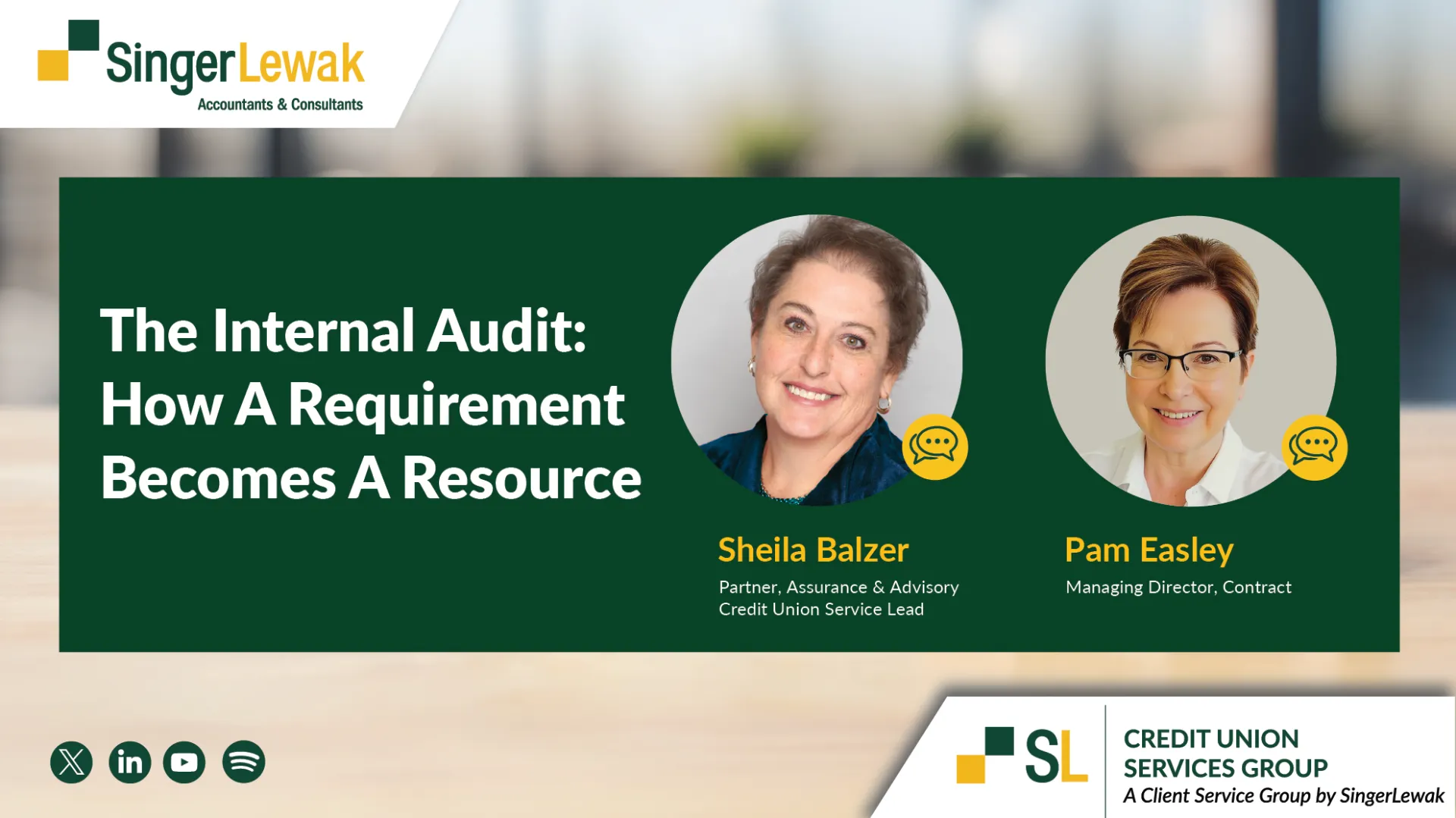
As Sheila Balzer, Partner, SingerLewak Assurance & Advisory and Credit Union Lead puts it:
“Internal audits are most valuable when they combine institutional knowledge with independent insight. That’s where organizations uncover the most meaningful opportunities for improvement.”
From Compliance to Strategic Function
Traditionally, internal audits focused primarily on controls, testing, and compliance. While those functions remain essential, they are inherently backward-looking. Today’s credit unions operate in a far more dynamic environment shaped by expanding digital platforms, increased reliance on third-party vendors, heightened regulatory scrutiny, and more complex risk profiles.
As a result, internal audits must evolve alongside the business itself. Credit unions are no longer asking only:
“Did we do things right?”
Increasingly, they must ask:
“Are we prepared for what’s next?”
A modern internal audit function helps organizations evaluate not only whether controls are effective today, but whether they will continue to support the institution as operations, technology, partnerships, and member expectations continue to evolve.
Why the Risk Landscape Demands More
Risk isn’t just growing, it’s shifting. Today’s credit unions are navigating rough seas.
- Cybersecurity threats evolve daily
- Fraud schemes are more sophisticated than ever
- Interest rate volatility and economic uncertainty
- Operational complexity driven by partnerships and outsourcing
These aren’t static risks. Like a virus, they can mutate. They require dynamic oversight.
An effective internal audit function helps organizations identify emerging risks before they escalate, prioritize the issues that matter most, and surface operational or control gaps that might otherwise go unnoticed. It also helps ensure risk management strategies remain aligned with broader organizational goals.
In today’s environment, internal audit is no longer simply about validating compliance. It is about providing leadership, supervisory committees, and boards with meaningful insight that supports better decisions and stronger long-term governance.
The Power of Independent Perspective
Even the strongest internal teams can’t see everything. Familiarity creates efficiency, but can also create blind spots.
That’s where external support makes a measurable difference.
Independent expertise strengthens objectivity and governance while introducing broader industry insight and specialized experience. External advisors can also expand internal capacity without overextending existing teams and help ensure alignment with evolving regulatory expectations.
Internal knowledge explains how things work. External perspective challenges whether they’re working as effectively as they could.
An Early Warning System
One of the most overlooked benefits of an internal audit is its ability to act as an early detection mechanism, not simply a scorecard.
When audit plans are aligned with real-time risk:
- Vulnerabilities are identified before they become issues
- Critical risks are elevated to leadership and boards
- Communication across governance structures gets better
- Innovation is supported by strong, scalable controls
Pam Easley, SingerLewak Contract Managing Director notes:
“The true value lies in the independence and transparency of the review, ensuring the organization is operating in a safe and sound manner.”
However, Easley adds:
“The key in this current climate is to see the continued value of the internal audit where any sized organization may be changing the way it conducts business, relying more on third parties or have strategic objectives that may be different or imposes a level of complexity.”
Balzer and Easley both agree that as the industry becomes more complex, higher-stakes result from rapid growth initiatives, mergers, the launching of updated digital products or even member service model expansion, ensuring innovation and new avenues are supported by sound controls environments continue to emphasize the importance of internal audit to highlight independently whether the paths chosen continue to mitigate potential future risk or even a modification of the current risk approach of the credit union.
Make Internal Audits Work Harder for You
An internal audit should never feel like something an organization just needs to “get through.”
When approached strategically, it becomes a valuable business resource that supports stronger governance, sharper risk management, and more confident decision-making.
At SingerLewak Credit Union Service Group, we help credit unions elevate internal audits using independent insight, forward-looking risk assessments, direct industry operating experience, and practical recommendations designed to create meaningful operational impact.
The goal isn’t better audits. It’s building a stronger, more resilient organization, better prepared for what comes next.
Let’s Rethink What Internal Audit Can Do
Ready to elevate your internal audit approach? Connect with Sheila Balzer and the SingerLewak Credit Union Services team to learn more.
Sheila Balzer
Partner, Assurance & Advisory
Credit Union Service Lead
SingerLewak
📞 720.330.8160
✉️ [email protected]