Attracting and retaining talented employees is essential to fulfilling your credit union’s mission of member service. A competitive and well-managed benefits package plays a central role in that effort. However, employee benefit plans (EBPs) come with complex rules and regulatory requirements that demand careful oversight.
For HR leaders, ensuring compliance isn’t just a finance function—it’s a critical risk management responsibility. One of the most effective ways to safeguard your organization and your employees is through a thorough and properly executed EBP audit.
Why EBP Audits Matter More Than Ever
Today’s regulatory environment is constantly evolving, and EBPs are subject to strict oversight under the Employee Retirement Income Security Act (ERISA). If your plan has 100 or more participants with account balances, you are required to include audited financial statements with your annual Form 5500 filing.
Being prepared for a Department of Labor (DOL) review is crucial. Noncompliance can result in penalties, litigation, and costly fees—risks that HR leaders cannot afford to overlook.
The Hidden Risk: Inexperienced Auditors
Not all audits are created equal. The quality of your EBP audit is heavily influenced by the experience of the audit firm you engage.
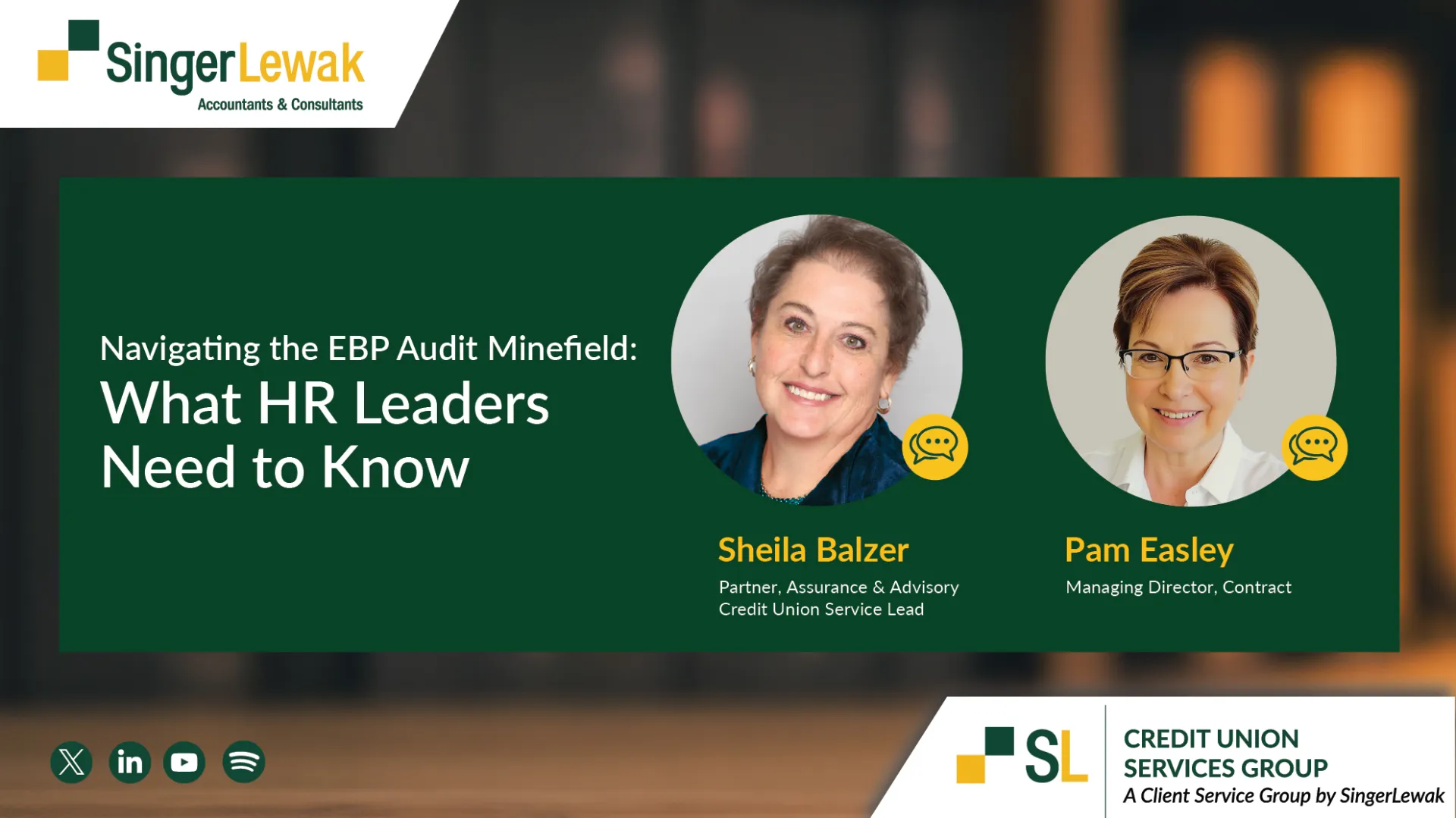
As Sheila Balzer, Partner and Credit Union Services Lead at SingerLewak, explains:
“Too many companies engage auditors who don’t have an in-depth understanding of plan provisions or compliance.”
This lack of specialization can lead to inefficient, time-consuming audits—or worse, audits with deficiencies.
Sheila adds:
“An interesting figure is that 30% of EBPs were exposed as having one or more major deficiencies. That’s what a Department of Labor study found earlier this year.”
While that number may not seem alarming at first glance, the broader implication is significant.
“Three out of ten doesn’t sound so awful, but they only looked at about three hundred plans,” Sheila explains. “If you applied that percentage to all credit unions in the country, there could be more than 1,400 in a worrisome situation.”
Specialization Makes a Measurable Difference
The same DOL study revealed another critical insight: experience matters.
“The study found that firms performing five specialized EBP audits or less per year had significantly more deficiencies than those who performed more than five,” Sheila notes.
For HR leaders, this reinforces the importance of selecting an audit partner with deep, specialized experience in employee benefit plans—especially within the credit union space.
What HR Leaders Should Be Asking
When evaluating your current or prospective audit partner, consider the following questions:
- How many EBP audits do they perform annually?
- Do they understand credit union-specific plan structures?
- Can they proactively identify compliance risks before they become issues?
Choosing the right audit partner isn’t just about checking a box—it’s about protecting your employees and your organization.
Partnering for Confidence and Compliance
As with any audit, partnering with an experienced professional is essential. A firm that understands the complexities of EBPs—and takes the time to perform a comprehensive review—can help you avoid unnecessary risk and ensure your plan remains compliant.
SingerLewak’s Credit Union Services Group brings deep industry expertise and a specialized approach to EBP audits, helping HR leaders confidently navigate even the most complex requirements.
Take the Next Step
If you’re unsure whether your current EBP audit approach meets today’s standards—or if you want to reduce risk and improve efficiency—it may be time for a conversation.
Connect with Sheila Balzer to discuss your plan, your challenges, and how a specialized EBP audit can support your organization’s long-term success. Let’s make your next audit your strongest one yet.
Contact Information
Sheila Balzer
Partner, Assurance & Advisory
Credit Union Services Lead
SingerLewak
Phone: 720.330.8160
Email: [email protected]